English
 Arabic


In today’s construction and landscaping industry, efficiency and cost optimization have become just as important as aesthetics. This is especially true in markets such as the United States, Europe, and Australia, where labor costs continue to rise.
As a result, many contractors and developers are shifting toward pool mosaic tiles as a more practical solution for swimming pool paving. Compared to traditional small-format tiles such as 10×10×1cm marble, mosaic tiles offer significant advantages in installation speed, labor efficiency, and overall project cost.

What Are Pool Mosaic Tiles?
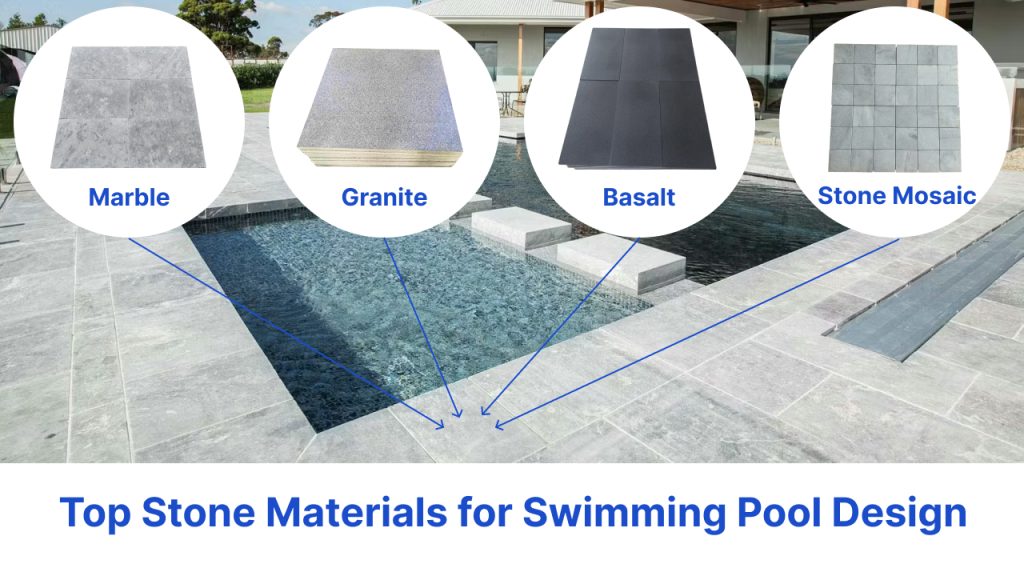
Pool mosaic tiles are pre-mounted small stone pieces, typically fixed on mesh backing sheets. Instead of installing each piece individually, installers can place an entire sheet at once, ensuring faster and more consistent installation.

These mosaic tiles are commonly made from natural materials such as:
- – Marble
- – Natural stone blends
- – Selected textured stones suitable for wet areas
They are widely used in:
- – Swimming pool interiors
- – Pool walls and waterlines
- – Spa and wellness areas
- – Decorative pool features
Why Mosaic Tiles Are Gaining Popularity in Pool Paving
1. Faster Installation
One of the biggest advantages of pool mosaic paving is installation efficiency.
Instead of placing hundreds of individual 10×10 tiles, workers can install pre-arranged mosaic sheets, significantly reducing:
- – Installation time
- – Labor intensity
- – Risk of uneven alignment
This is particularly valuable in high-cost labor markets.
2. Reduced Labor Costs
In regions like the US, Europe, and Australia, labor costs often account for a large portion of project expenses.
By switching to mosaic pool tiles, developers can:
- – Reduce installation time
- – Minimize labor requirements
- – Improve overall project efficiency
This makes mosaic tiles a cost-effective alternative without compromising design quality.
3. Better Adaptability for Pool Design
Swimming pools often include:
- – Curved edges
- – Steps and seating areas
- – Complex shapes
Mosaic tiles adapt easily to these structures, allowing for:
- – Smoother finishing
- – Less cutting and waste
- – More precise detailing
4. Consistent and Refined Appearance
Because mosaic tiles are pre-arranged, they provide:
- – Even spacing
- – Consistent layout
- – Cleaner visual results
This helps maintain a high-end appearance, especially in luxury pool projects.
From 10×10 Marble Tiles to Mosaic: A Practical Shift
Traditionally, 10×10×1cm marble tiles have been widely used in pool paving due to their durability and natural beauty. However, they require:
- – Individual installation
- – More time-consuming labor
- – Higher installation costs in developed markets
Recognizing these challenges, many suppliers and developers are now transitioning to pool mosaic tiles as a more efficient solution.
This shift is not about replacing natural stone, but about optimizing how it is used, maintaining the beauty of marble while improving installation efficiency.
Applications of Pool Mosaic Tiles
Pool mosaic tiles are suitable for:
- – Swimming pool interiors
- – Poolside decorative zones
- – Water features and fountains
- – Spa and wellness centers
- – Residential and commercial pool projects
They are especially effective in projects that require both precision and visual detail.
Why Pool Mosaic Tiles Are the Future of Pool Paving
As construction trends continue to evolve, materials that combine efficiency, aesthetics, and cost control will dominate the market.
Pool mosaic tiles offer:
- – Faster installation
- – Lower labor costs
- – Flexible design applications
- – Consistent visual quality
For developers and contractors working in high-cost labor markets, mosaic tiles represent a practical and forward-thinking solution.
Conclusion
The shift from traditional 10×10 marble tiles to pool mosaic tiles reflects a broader trend in the construction industry: optimizing materials for efficiency without sacrificing quality.
For modern pool projects, especially in international markets, pool mosaic paving is becoming the preferred choice, offering both aesthetic appeal and real economic benefits.